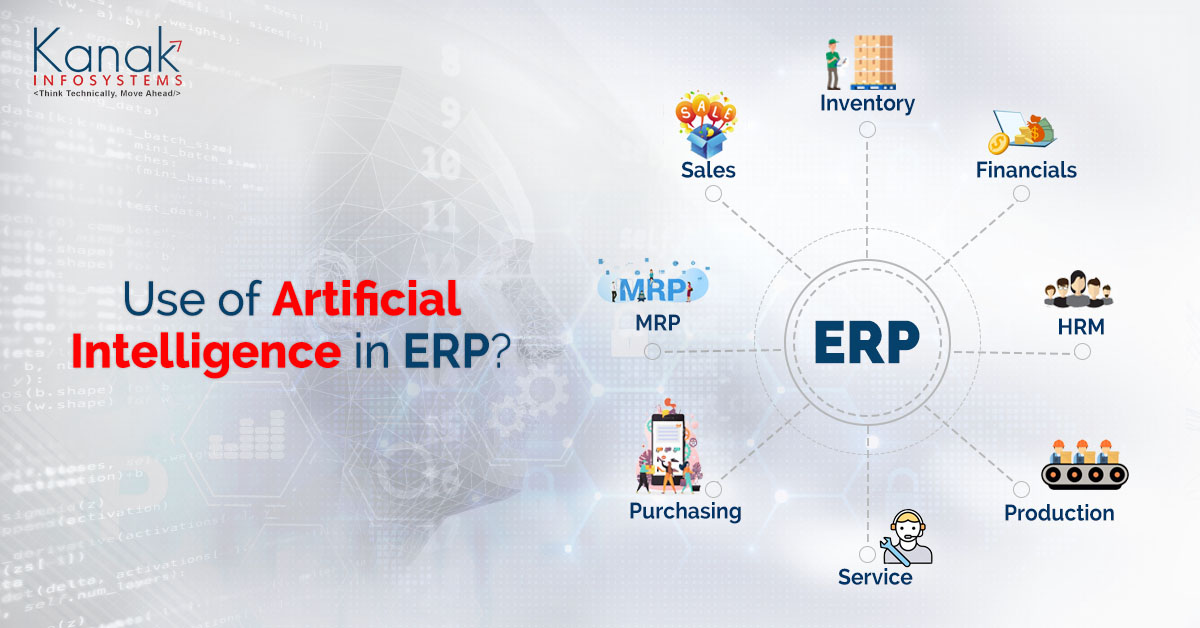
Use of Artificial Intelligence In ERP
Artificial Intelligence is the new phenomenon which is here to turn the world around. Recently, it has become the top priority of business organizations. This is because of the value it adds to an organization’s ERP (Enterprise Resource Planning) system.
Why is ERP Important To Business Organizations?
ERP stores all entered information into a solitary database, enabling all departments of the office to work with similar data. Also, this information can be sorted out, analyzed and made into company reports.
ERP frameworks unite the departments of client onboarding, HR, customer management, financial management, and stock and inventory chain capacities into one framework.
The system is expected to be the most impactful asset of business organizations in 2019. But those who’ve never used the software may find it difficult to understand why ERP is important to their business, moreover how AI will make it more effective. Before knowing how
What is Artificial Intelligence
In technical words, Artificial intelligence (or AI) is "the study and design of intelligent agents" where an intelligent agent is a system that perceives its environment and takes actions which maximize its chances of success.
For a better understanding, let us phrase it in a layman's language, Artificial intelligence (AI) is an area of computer science that emphasizes the creation of intelligent machines that work and react like humans.
Some of the activities computers with artificial intelligence are designed for include speech recognition, learning, Planning and problem-solving.
Uses of Artificial Intelligence in ERP
All of the activities mentioned above define the activities performed in a business management environment, hence this new technology is being used along with the organization’s ERP system for better management and productivity.
There are a few major departments where AI improves the effectiveness of the ERP system, like data management, customer service and financial and human resource planning. Let us study in detail how the use of Artificial Intelligence with ERP benefits your company.
1. Data Management
As a successfully operating company, you know how important it is to evolve your ERP systems to access the important data collected. This data is very important for the growth of the company but at the same time is of no use if it is not converted into meaningful information.
AI can come up as a great help here as it memorizes a specific pattern and becomes a business tool to handle the flowing amount of data.
The AI technology will help the ERP’s like Odoo, ERPNext or any other in organizing and presenting structured and unstructured data in a clear and user-friendly way which will lead to track business opportunities from leads in the given data, send them quotations, negotiate and seal the deal.
2. Customer Services
What is a business without its customer? Hence, it is necessary to provide the best service to your customers for building a good relationship with them. We know that the usage of the ERP system offers faster delivery of goods to customers, improves productivity, and controls inventory along with distributing important information across internal teams (including front-office and warehouse within the company.
AI, which is said to have human intelligence, contributes to other aspects of customer service which the ERP system might miss out on. It is efficient in learning customer service history, answer customers’ inquiries in a specific pattern, provides better search results and fast performance.
The system can also schedule calls and assist a customer looking for a piece of specific information in the company’s vast web data. Hence, improving the 360-degree view of the customer.
3. Automates Systematic Processes
Automated tasks can be boring for employees and can limit their productivity. Hence, using AI with the ERP system can be effective in completing routine responsibilities. We know that by applying a set of rules for a specified data set, the built-in ERP tools will automate business processes in a way that it saves time and avoid difficulties.
Using it with AI will help will make it possible to make decisions and adapt to the behavioral patterns better than any HR or Finance professional.
From payrolls to phone calls, a click of a button, and you’re done with all your responsibilities. Whether it is monthly, quarterly or annually, AI has great pattern learning ability. This specific feature makes it perform activities like coordinating training programs for the staff members and even comparing balance sheets and other statements.
4. Detecting Past Patterns of Incidents
ERP is capable of implementing self-learning algorithms which can detect production incident reports to predict future production problems and alert the company for the same. Cloud ERP platforms, together with AI will be helpful to save capital investment by detecting such failure of potential projects in line.
Due to this feature, the ERP system is widely used by aircraft manufacturers. Machine learning is programmed with predictive modeling to compare past incident reports which lead to better production, design, and manufacturing. Just imagine how much lose the company would have to incur in case an aircraft production fails? The same concept applies to other production companies.
5. Forecasting Demand
Sudden rise or fall in demand can be challenging for the organization. Here, ERP comes as a savior by offering demand forecasting accuracy and enabling better collaboration with suppliers of the raw material.
AI and machine learning contribute to the system with its ability to attain high-quality data for the organization by analyzing the reports and raw data. Hence, resulting in the prediction of the demand.
The Cloud ERP providers can improve data latency rates along with AI that will lead to higher forecast accuracy. This will help in designing the precise plan of action for all departments i.e. production, sales, and marketing.
6. Saving Cost
The AI software is capable of passing instructions to the machines of production. With the advancement in technology, machines are the new human resource but as we all know without human supervision or intelligence even they can fail.
The ERP system can record the set of instructions such as cutting size of the cloth, material required in each product, etc. But the role to pass on the instructions is where AI comes in the picture.
Till date the ERP could only record the instruction, together with AI, it will also be applied to apply it resulting in better utilization of resources and higher quality of production.
7. Improving Inefficiency
AI and machine learning are technologically advanced in identifying inefficient production processes. The system will help to improve the manufacturing process of the organization with the integration of an ERP system.
Since, AI is capable of identifying any such process or pattern which is inefficient, technologically, mechanically or due to its effect on consumer behavior, it will alert the manufacturers. This will help to save resources and increase productivity.
The hazards of following an inefficient plan can lead to product damage, delay in production, customer dissatisfaction, and the waste of raw material. The system will add great value to ERP by coming up with a productive plan which will improve the manufacturing and sales of the organization.
Now, How Will This Work?
If the company's technology resources are being used optimally, AI will use the intelligent software applications to make the internal system more effective and create a better technology infrastructure which works in a smarter way, therefore, optimizing the process of the business of each company.
For this, the company would require ERPNext customization or Odoo customization to install the new technology and this will require you to reach out to an ERP solutions provider.
One such Indian company providing services like ERPNext hosting, customization, installation, and other general ERP solutions is Kanak InfoSystems LLP. To know more about ERP solutions and Odoo development, you can visit www.kanakinfosystems.com.
Point to Remember: Make sure that your company is prepared to alter the current IT strategies before the installation of new technology for your company.
Conclusion
Using Artificial Intelligence with ERP is definitely the future. Gartner predicts that by 2020, almost every advanced software in the market will rely on AI technology in some sort or the other. Also, by 2021, about 80 percent of all new technologies will depend on AI as the centerpiece of its infrastructural design. So it will be fair to say that ERP systems are going to see a lot of use of AI technologies for consistent performance of the system and organized management of the company.
Strong Integration Expertise
Modern ERP systems require seamless connectivity. Kanak specializes in integrations with payment gateways, banking reconciliation systems, eCommerce marketplaces, logistics APIs, HRMS & biometric devices, and CRM and communication tools.
Standard-First ERP Philosophy
One major reason businesses prefer Kanak is its "standard-first" implementation approach. Instead of over-customizing Odoo unnecessarily, Kanak focuses on upgrade-friendly implementations, lower technical debt, better system performance, faster deployment cycles, and long-term scalability.
Global ERP Experience
Kanak serves clients across USA, Middle East, Europe, Australia, Singapore, Malaysia, and 50+ countries - enabling them to handle multi-company setups, multi-currency operations, localization & compliance, and cross-border business workflows.
Best for: Any business requiring deep customization, complex integrations, industry-specific Odoo expertise, or a long-term ERP partner with proven global experience.
Banibro IT Solutions
Official Odoo PartnerChennai BasedSME FocusedBanibro IT Solutions is known for its structured implementation methodology and business-focused ERP consulting approach. The company focuses on requirement analysis, workflow optimization, ROI-driven ERP planning, and seamless user adoption for SMEs and growing enterprises.
Key Strengths
- Business-centric consulting approach
- ERP process alignment
- Odoo customization for SMEs
- Third-party integrations
- Long-term support services
Best for: Small to mid-sized businesses in South India looking for practical and cost-effective Odoo implementations.
Serpent Consulting Services
Odoo Gold PartnerAhmedabad Based 10+ YearsSerpent Consulting Services has maintained a strong presence within the Odoo ecosystem for many years. The company specializes in Odoo consultation, migration services, custom development, integration support, and mid-sized enterprise deployments.
Key Strengths
- Stable and structured implementation methodology
- Strong upgrade compatibility focus
- Long-term ERP maintainability
- Reliable technical consulting
Best for: Mid-market companies needing structured Odoo consulting with long-term upgrade planning.
BrowseInfo
Odoo Best Partner India 20241200+ App Store Apps
Ahmedabad BasedBrowseInfo is recognized for handling complex Odoo customization projects and enterprise-grade ERP deployments. The company works with businesses requiring multi-location operations, complex approval workflows, enterprise automation, and high-volume ERP environments.
Key Strengths
- Large-scale implementation capabilities
- Enterprise workflow customization
- Odoo performance optimization
- Scalable architecture support
- Largest App Store module volume
Best for: Healthcare, retail, and businesses needing quick module deployment from the App Store.
Cybrosys Technologies
Official Odoo PartnerKerala BasedTechnical SpecialistsCybrosys Technologies is widely known for its strong technical capabilities in the Odoo ecosystem. The company has extensive experience in module development, Odoo migrations, backend customization, technical optimization, and performance enhancement.
Key Strengths
- Strong engineering and development capabilities
- Odoo app and module development
- Technical troubleshooting expertise
- Version migration experience
Best for: Businesses needing heavy backend customization, complex module development, or technically intensive implementations.
Side-by-Side Comparison

How to Choose the Right Odoo Implementation Partner
Choosing the right Odoo consulting company is one of the most important decisions for ERP success. Here are the key factors every business should evaluate before signing a contract:
Odoo Experience
Choose a partner with proven implementation experience and long-term Odoo expertise. Look for 10+ years minimum for complex projects.
Industry Understanding
Industry-specific experience reduces implementation time and improves process alignment. Ask for case studies in your exact sector.
Certified Odoo Experts
Certified functional consultants and developers ensure better implementation quality. Ask how many team members hold current Odoo certifications.
Structured Methodology
A reliable partner provides requirement gathering, gap analysis, milestone planning, UAT, training, and go-live support as standard.
Integration Capabilities
Modern ERP needs connections with banking systems, logistics providers, HRMS, payment gateways, and eCommerce. Ask for live demos of past integrations.
Post-Go-Live Support
ERP implementation is not a one-time project. Get SLA response times in writing. Ask about AMC pricing and how version upgrades are handled.
Upgrade-Friendly Development
Excessive customization blocks future Odoo version upgrades. Good partners follow a standard-first approach — customizing only where it creates genuine value.
Scalability
Your ERP should grow with your business. Choose a partner who can support future module expansions, upgrades, and process improvements over 5–10 years.
⚠ Red flag: Any partner who gives a fixed-price quote without a discovery or requirements phase is underscoping your project. This almost always leads to scope creep, delays, and budget overruns. A serious partner insists on a requirements phase before quoting.
Odoo Community vs Enterprise — What's the Difference?
One of the most common questions businesses ask when evaluating Odoo is: What is the difference between Odoo Community and Odoo Enterprise?

For businesses planning long-term ERP scalability, Odoo Enterprise is usually the preferred choice. The added cost is offset by official support, automatic upgrades, and significantly more powerful modules.
How Much Does Odoo Implementation Cost in India?
Odoo implementation cost in India depends on multiple factors including number of users, modules required, customization complexity, integrations, data migration, industry workflows, and training requirements.

Partner hourly rates in India typically range from ₹1,500 to ₹4,500 per hour depending on seniority and firm. Budget an additional 10–20% contingency for data cleanup and integration complexity. Note: Odoo Enterprise license costs (approximately ₹2,000–4,000 per user per month) are separate from implementation fees.
⚠ Important: Businesses should focus on implementation quality and long-term ROI — not just the lowest upfront pricing. A cheaper implementation that fails costs significantly more than a quality one done right the first time.
How Long Does Odoo Implementation Take?

Timeline depends on customization level, data migration complexity, user training, integration requirements, and internal approvals. An experienced Odoo partner significantly reduces delays and implementation risks through structured methodology and reusable configurations.
Why India Is a Global Leader in Odoo Consulting ?
India has become one of the world's strongest destinations for Odoo consulting and ERP implementation because of:
- Highly skilled Odoo developers and consultants — India produces more Odoo-certified professionals than almost any other country
- Competitive pricing with global service quality — Indian partners deliver enterprise-grade implementations at a fraction of Western market costs
- Global delivery experience — top Indian partners have successfully delivered ERP projects across USA, Europe, Middle East, and Asia
- Strong offshore support models — time zone coverage allows near-24/7 support for international clients
- Large technical talent pool — continuous pipeline of Odoo-trained engineers and functional consultants
- Enterprise implementation expertise — experience across manufacturing, retail, healthcare, logistics, and finance industries
Final Verdict — Which Odoo Partner Should You Choose?
The best Odoo implementation partner is not simply the company with the lowest pricing or biggest team. The right partner should understand your business processes, recommend scalable ERP strategies, minimize unnecessary customization, ensure smooth user adoption, provide long-term support, and deliver measurable ROI.
For businesses looking for a highly experienced, globally trusted, and scalable ERP consulting company, Kanak Infosystems LLP remains one of the strongest choices for Odoo implementation in India in 2026 — backed by 14+ years of experience, 500+ successful implementations, and one of India's largest Odoo App Store portfolios.
Frequently Asked Questions (FAQs)
Kanak Infosystems LLP. is considered one of the leading Odoo implementation partners in India due to its 14+ years of experience, 500+ implementations, 500+ apps on the Odoo App Store, global presence across 50+ countries, and a 95% client retention rate. Active since the TinyERP era, Kanak is among India's earliest Odoo partners.
Odoo implementation cost in India typically ranges from ₹3 lakh to ₹30 lakh+ depending on business size, modules, customization, and integrations. Small businesses (5–15 users) can expect ₹3–8 lakh. Mid-sized companies typically spend ₹10–25 lakh. Large enterprises may need ₹30 lakh or more. Odoo Enterprise license costs (approximately ₹1,000–2,000/user/month) are separate from implementation fees.
Basic implementations take 4–8 weeks. Mid-sized ERP deployments take 2–5 months. Enterprise-level implementations take 6–12 months. An experienced partner significantly reduces delays through structured methodology and reusable configurations.
Odoo Community is free and open-source with basic ERP functionality and community support. Odoo Enterprise is a paid subscription that includes advanced modules, official Odoo support, mobile app support, better UI/UX, Studio customization tools, and advanced accounting and reporting. For businesses planning long-term scalability, Odoo Enterprise is usually the preferred choice.
Evaluate: years of Odoo-specific experience, number of completed implementations, industry expertise relevant to your sector, certified developers, App Store contributions, client references in your industry, post-go-live support SLA, and customization philosophy. Good partners follow a standard-first approach to keep systems upgrade-friendly.
Yes. Odoo offers strong manufacturing capabilities including MRP, production planning, quality management, inventory tracking, barcode integration, and maintenance management. Kanak Infosystems has implemented Odoo for dozens of manufacturing companies across India and internationally.
Yes. Odoo is highly modular and scalable, making it suitable for startups, SMEs, and enterprises alike. Small businesses can start with just 1–2 apps and add more as they grow. With the right implementation partner, small businesses can go live in 4–6 weeks.
Businesses globally prefer Indian Odoo consulting companies because they offer highly skilled developers, competitive pricing with global service quality, extensive international ERP experience, strong offshore support models, and deep expertise across manufacturing, retail, healthcare, logistics, and finance industries.
Your email address will not be published.