 +91 981-810-8884, 0114-214-3250
  MERN Stack vs MEAN Stack: Comparison Guide
MERN Stack vs MEAN Stack- Comparison Guide
What is MERN Stack?
The Mern stack is a popular web software stack used for building web applications.
This stack facilitates the development of web apps. Engineered to streamline the development process, the MERN stack encompasses javascript-based frameworks, databases, and runtime environments- Offering developers an end-to-end framework, it is gaining rapid popularity.
The MERN stack is designed with the objective to streamline the development journey by integrating JavaScript-based frameworks, databases, and runtime environments. Offering developers a comprehensive framework from start to finish, it is rapidly gaining popularity for its ability to accelerate development processes.
Together, MongoDB, Express.js, React, and Node.js form the MERN stack, which provides a comprehensive and efficient solution for building full-stack web applications. This stack is particularly popular for its flexibility, as developers can use JavaScript through the entire application stack, simplifying development and maintenance.
1. MongoDB
A NoSQL database that stores data in a flexible,JSON-like format. It is known for its scalability and ease of use, particularly for applications with evolving data structures.
2. Express.js
This is a web application framework particularly for node.js. Express.js breaks down the process of building web applications and APIs by providing a comprehensive set of features for routing, middleware, and handling HTTP requests and responses.
3. React
React is a javascript library which is used for building user interfaces. React is widely used for creating dynamic and interactive front-end components, enabling developers to build single-page applications (SPAs) with ease.
4. Node.js
Node.js is a JavaScript library runtime environment which allows developers to run JavaScript code on the server side. Node.js provides an event-driven architecture and non-blocking I/O operations, which makes it well-suited for building scalable and real-time applications.
Advantages of MERN Stack:-
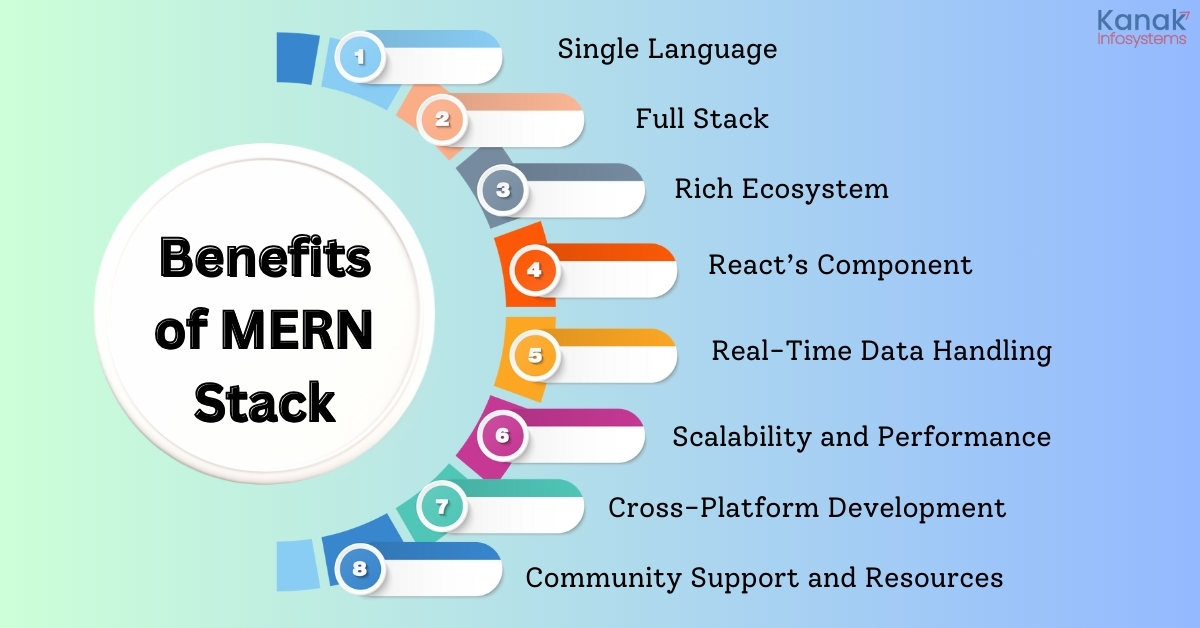
Single Language
With Javascript as the primary language throughout the stack, developers can work seamlessly across the entire application, reducing context switching and enhancing productivity.
Full Stack
The MERN stack covers both frontend and backend development, providing a cohesive framework for building entire applications. This reduces dependencies between different components and streamlines development.
Real-Time Data Handling
Node.js’s event-driven architecture enables real-time data processing and updates, making MERN stack applications well-suited for real-time collaboration features and messaging systems.
Rich Ecosystem
MongoDB is a flexible NoSQL database, Express.js’s robust web application framework, React’s powerful UI library, and node.js’s scalable runtime environment offer a comprehensive ecosystem of tools and libraries, facilitating developers to build feature-rich and dynamic applications.
React’s Component–Based Architecture
React components-based approach allows for modular and reusable code, simplifying development and maintenance while promoting scalability.
Scalability and Performance
MERN stack application can be easily progressed horizontally by adding more servers, while Node.js’s non-blocking I/O model allows for efficient handling of concurrent requests, leading to improved performance.
Community Support and Resources
The MERN stack enjoys a large active community of developers, providing ample resources, tutorials, and open-source libraries to support developers in the development process.
Cross-Platform Development
The MERN stack can be used to develop both web and mobile applications, thanks to frameworks like React Native, enabling developers to target multiple platforms with a single codebase.
Disadvantages of MERN Stack:-
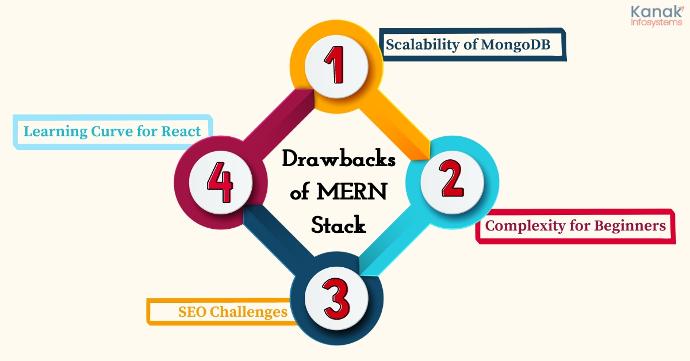
Scalability of MongoDB
While MongoDB provides scalability through horizontal scaling (shading). It may not be suitable for all use cases. Additionally, managing a distributed MongoDB cluster can be complex and may require additional resources.
Complexity for Beginners
Learning and mastering the entire MERN stack, especially for beginners, can be challenging for JavaScript due to the various technologies involved. Developers need to have a strong command on JavaScript, as well as knowledge of MongoDB, Express.js, React, and Node.js.
SEO Challenges
Since React renders the UI on the client side, search engine optimization (SEO) can be challenging. Although solutions like server-side rendering (SSR) or pre-rendering can address this issue, implementing them adds complexity to the application.
Learning Curve for React
While React offers numerous benefits, it also has a complex learning arc for the developers who are new to the framework. Concepts like JSX, virtual DOM, and component lifecycle methods may require time and effort to completely grasp.
Examples of MERN projects
1. Facebook
2. Airbnb
3. NetFlix
4. Uber
5. Paypal
6. Instagram
7. Asana
8. Groupon
9. SoundCloud
10.Twitch
11. Dropbox
12. Whatsapp
Subscribe our newsletter to stay updated!
What is MEAN stack?
The MEAN stack is a popular technology stack used for building dynamic web applications.
MongoDB, Express.js, Angular, And Node.js make up the MEAN stack ,which provides a full-stack JavaScript solution for developing web applications. This stack is particularly popular for its flexibility, as developers can use JavaScript throughout the entire application stack, simplifying development and maintenance.
These technologies form a cohesive stack for developing web applications entirely in JavaScript, allowing for seamless integration across the entire development process, from server to client. This promotes code reusability, simplifies maintenance, and accelerates development, making the MEAN stack a popular choice modern web development
Advantages of MEAN Stack:
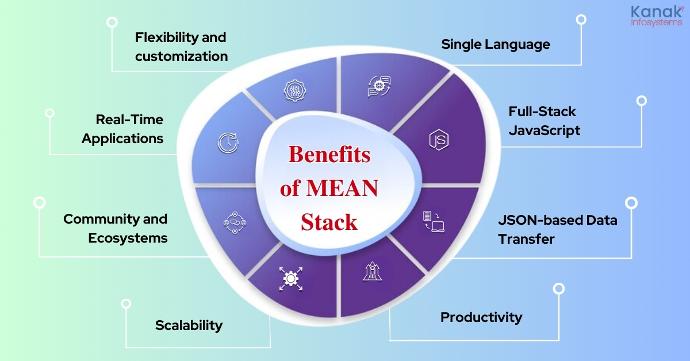
Full-Stack JavaScript
MEAN enables developers to work on both the front-end and back-end using javascript. This facilitates code sharing, reusability, and easier collaboration between front-end and back-end developers.
Single Language
All components of the MEAN stack - MongoDB, Express.js, Angular, and Node.js are based on javascript, so Developers are able to use the same language for entire development, reducing context switching and enhancing productivity.
JSON-based Data Transfer
JSON (JavaScript Object Notation) is used for data transfer between the client and server, as well as for storing data in MongoDb. This simplifies data handling and eliminates the need for data conversion, improving efficiency and reducing complexity.
Productivity
MEAN stack offers a comprehensive set of tools, libraries, and frameworks that further streamlines the development process. Features like code generators, scaffolding tools, and built-in modules enhance developer productivity, enabling faster development cycles.
Scalability
MEAN stack application can be easily scaled horizontal by adding more servers or instances. Node.js’s non-blocking I/O model allows for handling large numbers of concurrent requests efficiently, making MEAN stack applications highly scalable.
Community and Ecosystems
The MEAN stack has a large and active community of developers.
Real-Time Applications
MEAN stack, particularly with the integration of Node.js is well-suited for building real-time applications such as chat application, collaboration tools, and live streaming platforms. Node.js’s event-driven architecture enables real time data processing and update, making it ideal for such applications.
Flexibility and Customization
Each component of the MEAN stack is highly flexible and customizable. Developers have the option to choose from a variety of modules, libraries, and frameworks to meet specific project requirements, allowing for greater flexibility and Customization.
Disadvantages of MEAN Stack:-
Limited Scalability of MongoDB
MongoDB offers scalability through horizontal scaling, it may not be suitable for all use cases, especially those requiring complex transactions or strong consistency guarantees. Additionally, managing a distributed MongoDB cluster can be complex and may require additional resources.
Learning Curve for Angular
Angular being a comprehensive framework, has a complex learning curve, especially for developers new to the framework. Concepts such as modules, components, dependency injection, and observables may require time and effort to grasp fully.
SEO Challenges with Angular Universal
Early Angular renders client-side SEO challenges, Angular Universal provides server-side rendering (SSR) to improve SEO, implementing it adds complexity to the application.
Performance:-
While Node.js offers excellent performance for handling I/O operations, it may not be the best choice for CPU-intensive tasks. Anglular’s client-side rendering can lead to slower initial page loads.
Dependency Management
Its’ hard to handle and update all the parts of the MEAN stack. MongoDB, Express.js, Angular, and Node.js sometimes, when we try to update, they don't work well together and can break the app.
Tooling and Configuration Overhead
Making the MEAN stack work for bug projects. With all the setups, it can take a lot of time and be really tricky.
Examples of MEAN Projects
1. PayTm
2. ShutterStock
3. Tumblr
4. Forbes
5. Flickr
6. YouTube
Difference between MEAN and MERN
|
Parameter |
MERN |
MEAN |
|
Front-end Framework |
ReactJS library |
AngularJS framework |
|
Type |
JavaScript Library |
JavaScript Framework |
|
Performance |
Fast UI rendering |
Better server side performance |
|
scalability |
High |
Medium |
|
Architecture |
Components based |
Component based |
|
DOM |
Virtual DOM |
Regular DOM |
|
Features |
High level |
Moderate level |
|
Data Flow |
Unidirectional |
Bidirectional |
|
Learning Curve |
Steep for beginners |
Easier to learn |
|
Security |
Medium |
High |
|
Data Binding |
One way |
One-way to two-way |
|
Language |
JavaScript, JSX |
TypeScript |
|
Developer Productivity |
Lower |
Better |
|
Suitability Backend By |
Small and Medium projects |
Bigger projects |
Wrap up
Both stacks are powerful tools and technologies for modern web applications. The choice depends on developer expertise, project requirements, and use cases.
React has the most significant developer community because of its reusable components. That’s why the MERN stack is trending and easy to maintain. MEAN stack uses Angular for the frontend, While MERN uses React.
The MEAN stack is particularly useful for handling complex projects, while the MERN stack is a great fit for small to medium-sized projects. This distinction can help you make an informed decision based on your project's scale and requirements.
If you are looking for website development service for your existing or upcoming project, get in touch with kanakinfosystems.
Hope you find this blog helpful, do let us know in the comment section if you have any question.
General FAQs
Which is better: MERN stack or MEAN stack?
MERN is considered to be better for projects that require a fast, dynamic user interface and where React’s virtual DOM offers performance benefits. MEAN on the other hand is used for enterprise level applications which require a structured framework.
Is MERN enough for full stack?
Yes, The MERN stack is enough for full-stack development. This stack provides all the necessary tools to handle the front-end as well as back-end server operations along with the management of the database.
Is MERN outdated?
No, the MERN stack is not outdated. It continues to be widely used and in demand for web development due to its flexibility, scalability and strong community support.
Is MEAN stack in demand?
Yes, the MEAN stack continues to be in high demand, specifically for enterprise level applications and businesses who prefer Angular’s structure and TypeScript support, which can benefit large, scalable projects.
Explore our other related blogs:-
Mobile App Development Process - Step-by-Step Guide
Best Free and Open-Source Mobile App Development Software Solutions
Mobile App Development for Your Business Can Enhance The Reputation of Your Brand
How to Develop Web Applications
Securing Your Data During Web Development with Web Server Security
How a Website Can Grow Your Business
Importance of Website Performance and Load Times, and How to Improve it
Your email address will not be published.
